
What Size Furnace Do I Need for My Home?
Most Oklahoma homes need a furnace somewhere between 60,000 and 100,000 BTU, and a rough starting point is 30 to 40 BTU per square foot of conditioned space. So a 1,800 square foot house often lands around 60,000 to 70,000 BTU. That is a starting point, not an answer.
Two identical houses on the same street can need different furnaces depending on insulation, windows, ductwork, and how leaky the place is. Getting it right is the first thing we settle on a furnace installation and replacement quote.
The reason to care: a furnace that is too big is a worse problem than one that is slightly too small, and it is the more common mistake.
What BTU actually measures
BTU stands for British Thermal Unit. On a furnace, the number you see advertised is input BTU, meaning how much gas it burns per hour.
What heats your house is output BTU, and that is input times the efficiency rating. An 80,000 BTU furnace at 80 percent efficiency delivers about 64,000 BTU of heat. The same input at 96 percent efficiency delivers about 76,800. Two furnaces with the same sticker number are not the same furnace, which is why efficiency has to be part of the sizing conversation rather than an upsell tacked on afterward.
The square footage estimate, and where it fails
Run the rough math first so you have a ballpark:
1,200 square feet: roughly 36,000 to 48,000 BTU
1,500 square feet: roughly 45,000 to 60,000 BTU
1,800 square feet: roughly 54,000 to 72,000 BTU
2,400 square feet: roughly 72,000 to 96,000 BTU
Those ranges are wide on purpose, because square footage ignores almost everything that determines how fast a house loses heat.
Insulation and air sealing move the number most. A 1970s Tulsa house with original attic insulation and no air sealing can need a third more furnace than a well-built home the same size. Windows matter next: single-pane glass, or a lot of it facing west and north, adds load, and newer double-pane windows take it back off. Ceiling height counts too, because a furnace heats volume rather than floor area, so a vaulted living room needs more than its footprint suggests.
Then there is the ductwork, which is where a lot of sizing conversations should start and usually do not. Undersized or leaky ducts in an unconditioned attic lose heat before it ever reaches a room. A bigger furnace does not fix that. It just burns more gas feeding the same leak. Layout works the same way. Two-story homes, walkout basements, bonus rooms over garages, and additions nobody properly tied into the duct system all change how the heat has to get where it is going.
Why an oversized furnace is a real problem
This is the part that surprises people. When a furnace is too large, it heats the thermostat's little corner of the house quickly and shuts off. A few minutes later the temperature drops and it fires again. That is short cycling, and it causes four things:
Rooms stay uneven, because the system never runs long enough to move air through the whole house and mix it.
Ignition and shutdown are the hardest moments on a furnace, so more cycles per hour means more wear on the igniter, gas valve, and heat exchanger.
Efficiency drops, because a furnace is least efficient in the first minute of every cycle. More cycles means more of your gas burned during the inefficient part.
And it is loud. Constant on-off is more noticeable than a longer, quieter run.
An undersized furnace has a simpler failure: it runs almost constantly on the coldest nights and still cannot quite hold the setpoint. That is uncomfortable, but it is not chewing the equipment up. Given a choice between slightly small and significantly oversized, slightly small usually wins.
What a real sizing calculation looks like
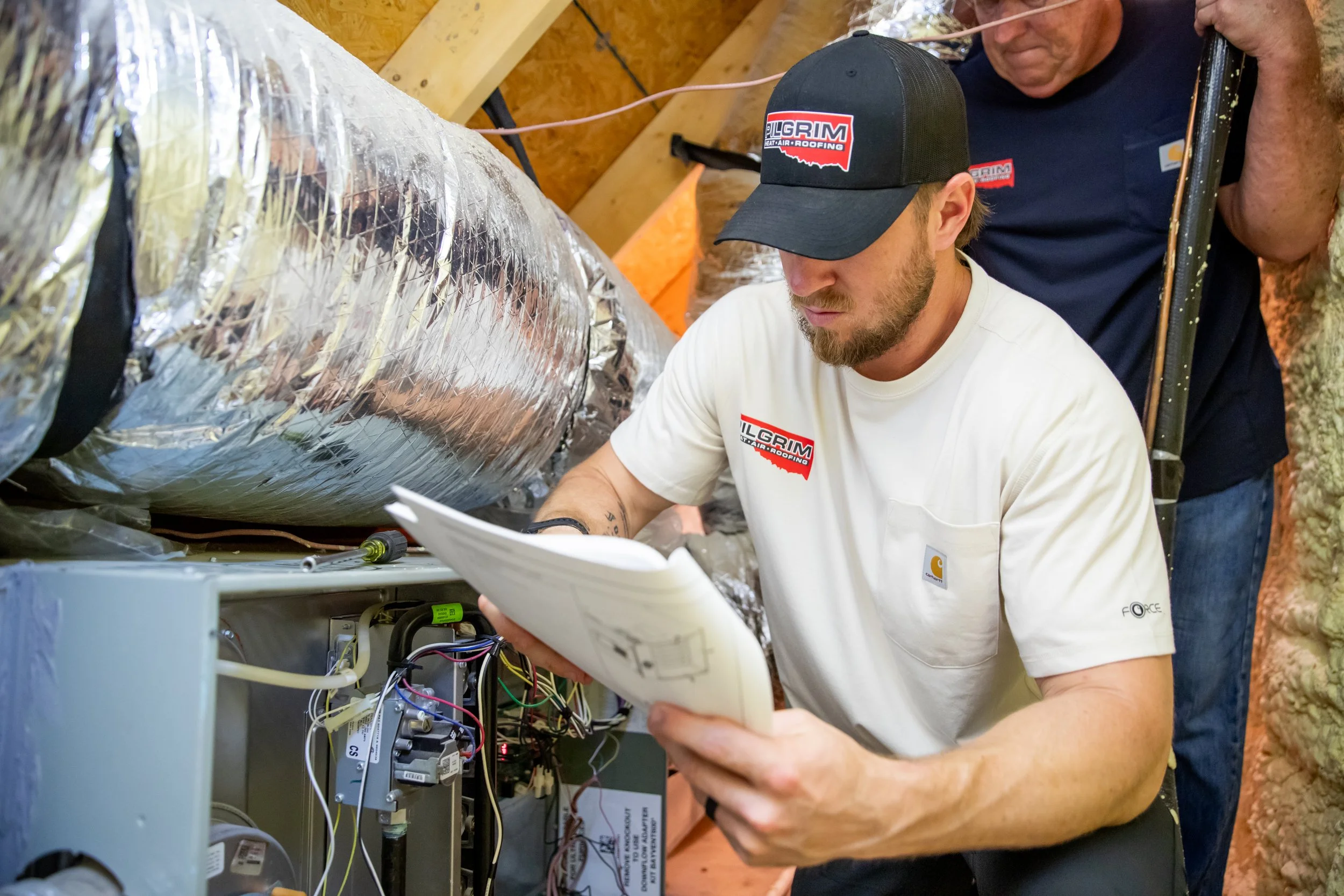
The proper method is a Manual J load calculation, which is the industry standard from ACCA. A tech measures the house, counts and rates the windows, records insulation levels in the attic and walls, notes orientation and shading, factors in air leakage, and calculates against the local design temperature. For the Tulsa area that winter design figure sits in the low teens, meaning the system is sized for the coldest conditions we reasonably expect rather than the coldest night in recorded history.
Two things a load calculation is not: it is not copying the number off your old furnace, and it is not a rule of thumb. Your old furnace may have been oversized when it was installed in 1998, and the house has probably had new windows or attic insulation since then. Repeating that number just repeats the mistake for another twenty years.
We also look at the ductwork while we are there, because the furnace and the ducts have to match. Putting a correctly sized furnace on a duct system that cannot carry the airflow gives you a temperature rise problem on day one.
If you are also replacing the AC
Do both at once when you can. The blower inside a furnace or air handler moves the air for both heating and cooling, so the two pieces of equipment have to be matched to each other and to the duct system. Sizing them separately, years apart, is how homes end up with a furnace that heats fine and a system that never dehumidifies properly in an Oklahoma July. Our guide on what size AC unit you need walks through the cooling side, where the same oversizing problem shows up as a house that is cold and clammy.
Frequently asked questions
How many BTUs do I need for a 2,000 square foot house?
Roughly 60,000 to 80,000 BTU as a starting range in Oklahoma, depending on insulation, windows, and ceiling height. A load calculation narrows it.
Is a bigger furnace better?
No. An oversized furnace short cycles, heats unevenly, wears out faster, and runs less efficiently. Right-sized beats big.
Can I just match the BTU of my old furnace?
Not reliably. Older systems were often oversized, and any insulation or window work you have done since then lowered the load.
What is a Manual J calculation?
The ACCA standard method for calculating a home's heating and cooling load using real measurements of the house rather than a rule of thumb. It is what a correct sizing is based on.
Does furnace efficiency change what size I need?
It changes the input rating you buy. Your house needs a certain output, so a higher-efficiency furnace reaches that output with a lower input number.
If your furnace is on its last winter, get the sizing settled before you shop equipment. We will measure the house, look at the ducts, and give you a straight recommendation with a price, whether you are in Tulsa or one of the surrounding towns. Call 918-366-3040, request an estimate, or see the rest of what we do on our heating and furnace service page.